
How to Avoid Inheritance Tax

How to Avoid Inheritance Tax?

09/08/2021Personal Tax , Tax Issues

When a person dies, inheritance tax is levied on the estate that is transferred to the heirs of the deceased by the government. If you’re planning to transfer the ownership of your estate to your children and loved ones without any deductions to get the optimal benefit from your estate, you might be wondering how to avoid inheritance tax. In this blog, we’ll be discussing few ways to avoid inheritance tax. Let’s explore!

Looking for an accountant to work out your IHT? Contact us right away!

What is Inheritance Tax?

This tax is levied on the estate of the person who has died. The estate includes all possessions, property and money a deceased has left. After the death of the person, the executor of the will must work out the estate and deduct any liabilities from it. The remaining amount will be entitled as “estate” on which inheritance tax is payable.

What is the Tax-free Threshold of Inheritance Tax?

If your estate is worth below £325,000 (nil rate band) and an extra £175,000 (transferring your main residents to direct descendants). Keep in mind that there is no inheritance tax payable if you are the deceased’s spouse or civil partner even if the estate worth is above the threshold.

Moreover, if you transfer your home to your children (adopted/foster/stepchildren or grandchildren) the threshold of inheritance tax can go up to £500,000.

In addition, if the value of your estate is below the threshold and you’re married /civil partnership, your unused tax-free threshold can be transferred to your partner, at the time of your death. It means they can have a threshold of up to £1 million.

So, it means you don’t need to pay inheritance tax if:

  • The worth of your estate is below the £325,000 threshold
  • You have left everything above £325,000 for your spouse, civil partner, a charity, community sports club or political party

How Much is the Inheritance Tax?

Currently, the inheritance tax is charged at a 40% rate on the value of the estate above the nil rate band/personal allowance. But, you can bring it down to 36% if you are donating above 10% to charity in your will.

Example

Let’s say the value of your estate is £700,000 and your tax-free threshold is £325,000. The inheritance tax will be levied with the 40% rate on £375,000 (£700,000 – £325,000)

Calculating your asset and keeping track of everything to find out the inheritance tax can daunting and time-consuming. Therefore, you need to talk to our accountants to find out how much inheritance tax you will pay after your death.

How to Avoid Inheritance Tax?

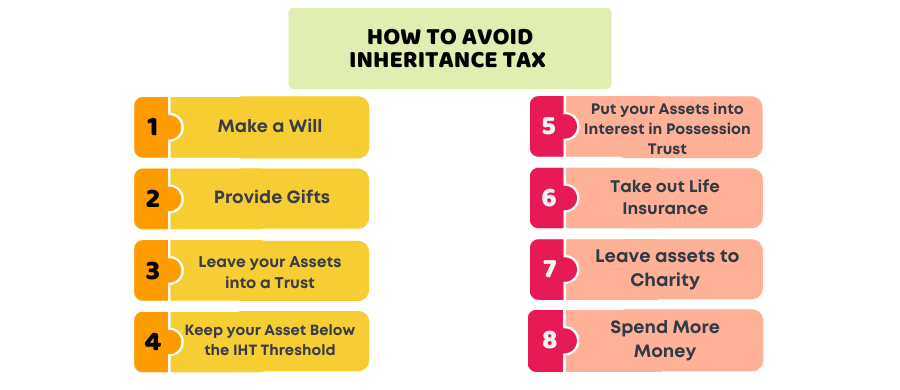
Want to know how to avoid inheritance tax legally? There are many ways to avoid or decrease inheritance tax on your estate. The following are the legal and tested ways to reduce or avoid inheritance tax:
How to Avoid Inheritance Tax


1) Make a Will

The simplest way to be saved from inheritance tax is to make a will. By making a will you can mention the people whom you want to transfer your estate after your demise. By doing it, you can better manage and control your estate as per your desire and can minimise your tax. If there’s no will, the government will decide to distribute them as per intestacy rules.

2) Provide Gifts

It is one of the great ways to reduce your inheritance tax. And there is no limit to the number of gifts. But if you give assets away and survive more than 7 years, then you don’t need to pay any tax on any of the assets that you gifted. But if you die earlier than 7 years, your estate will be taxed on a reducing scale.

3) Leave your Assets into a Trust

You don’t need to pay any inheritance tax on the assets that you put within a trust. These assets are IHT-free and can be given to your children when they turned 18.

4) Keep your Asset Below the IHT Threshold

Currently, in 2025 the inheritance tax threshold known as the nil rate band is below £325,000. This rate is transferable if your estate worth is below it. Additionally, the main residence transferrable allowance is £175,000. It means married couple or civil partners can pass their assets up to one million from IHT.

5) Put your Assets into Interest in Possession Trust

You can earn some interest in your estate by putting your assets into interest in a possession trust and can avoid IHT at the time of your death but you have to pay income tax on the amount your receive.

6) Cash out the Life Insurance

By taking out life insurance and putting it into the trust, you can be saved from the potential IHT bill.

7) Leave 10% to Charity

If you provide 10% of your assets to charity, the IHT rate for the rest of the assets will be reduced to 36%.

8) Spend More Money

One of the best ways to stay away from the 40% inheritance tax liability to your beneficiaries is to enjoy life by spending it to their utmost. You can enjoy your money by buying a new car or by going for a world tour, etc. This will reduce your IHT to the nil rate band and you can avoid it IHT.

Quick Sum Up

To sum up, you have got some important tips on how to avoid inheritance tax. By following these, you can leave a great portion of your wealth to your beneficiaries. In addition, you can gift them to your loved one when you’re healthy to remain alive for 7 years to avoid inheritance tax. Moreover, you can spend it yourself or you can donate it to a trust to avoid IHT. And there are multiple ways to reduce IHT like providing 10% of your wealth to charity, etc. By following the above tips, you can save a large sum of money.

Still, if you want more tips to avoid IHT, reach out to our accountants for expert advice!

Disclaimer: This blog provides general information on avoiding IHT.


Related post

nil rate band
What is the Nil Rate Band on Inheritance Tax?

25/09/2025tax

While death and taxes are unavoidable, the nil rate band offers a bit of relief, helping to transfer wealth to your loved ones without the taxman taking a cut. It is your pass to transferring wealth to the immediate descendants without triggering inheritance tax. It is also referred to as the nil rate band inheritance tax threshold and protects up to £325,000 in 2025. It becomes a relief for descendants who do not have to worry about the inheritance tax. Want to leave more for your loved ones? We will elaborate on what the nil rate band means, how it interacts with the IHT nil rate band rules, and why understanding the inheritance nil rate band might save you thousands. Talk to our best accountants and bookkeepers in the UK at CruseBurke. You will get instant help about the nil rate band. Nil Rate Band Inheritance Tax In the UK, the first line of defence against inheritance tax is the nil rate band. It is often referred to as the IHT nil rate band. This key threshold helps heirs save thousands on tax for estates valued under £325,000. But there are rules around transferring unused nil rate bands between spouses or civil partners. And this makes things a bit more complicated. Whether you’re sorting out your will or dealing with the loss of a loved one, understanding the inheritance nil rate band can really help reduce the amount of tax you need to pay. Why is the Nil Rate Band Important? The nil rate band is an important concept in the estate planning process as it has a direct effect on the amount of tax your family may pay. With property prices and asset values rising across the UK, more estates are at risk of going over the tax-free limit. This could mean losing a big chunk of your hard-earned wealth to HMRC instead of passing it on to your loved ones. But don’t worry, if you plan ahead, things can go in your favour. The good news is, the nil rate band serves as a shield. It allows a specific amount of wealth to be passed on without paying any IHT. It is also referred to as the nil rate band inheritance tax threshold, and it shelters descendants against huge taxes. To most, it is the secret of intelligent estate planning. How Does the Transferable Nil Rate Band Work What if a married person or civil partner dies and does not use their full £325,000 NRB? Well, in that case, the unused portion of the nil rate band can be transferred to the surviving partner’s estate. For example, if a husband dies and leaves his entire estate to his wife, this transfer is tax-free. As a result, the husband’s full nil rate band is unused. When the wife later dies, her executors can claim her own £325,000 NRB plus the full 100% of her husband’s unused allowance. This effectively doubles the available NRB for her estate, allowing a total of £650,000 to be passed on free of Inheritance Tax (IHT) to beneficiaries, such as their children and grandchildren. To make this claim, the executors of the second estate shall have to make an application to HMRC with evidence of the first death. It is available even when the first death happened before the transferable rules (09 October, 2007), provided that the latter death happens afterwards. This transferable nil rate band is a valuable benefit for married couples, as this may effectively increase the tax-free limit and safeguard even more of the wealth against the IHT nil rate band tax. Eligibility for Transferable Nil Rate Band To claim the transferable Nil Rate Band (TNRB), you must have been married or in a civil partnership at the time of the first death. The TNRB applies when the first spouse or civil partner dies without using their full £325,000 allowance. The unused portion can then be transferred to the survivor’s estate, potentially increasing the tax-free threshold to £650,000. Special cases for eligibility: Remarriage: If a surviving spouse remarries, they can claim the unused NRB from each deceased spouse. However, the total transferable NRB added to their own allowance is capped at 100% of the standard NRB. What does that mean?  Well, this means that a person’s NRB can be increased by a maximum of one full additional allowance. Even if they have been widowed more than once. Partial allowance used: If the first spouse used part of their allowance (e.g., leaving a gift to a non-exempt beneficiary), only the percentage of the NRB that was unused can be transferred Calculating IHT Using Nil Rate Band To calculate IHT, you have to calculate the full value of the estate, minus debt, funeral expenses, and exemptions. The remaining estate value is then compared to the nil rate band. Any amount above £325,000 will be subject to inheritance tax at 40%, except in other circumstances. For example, an estate valued at £400,000 would only pay 40% on £75,000, which is above the threshold, resulting in an IHT of only £30,000. £400,000 –  £325,000 =  £75,000 x 40% =  £30,000 (IHT) In the case of lifetime transfers (gifts), if the donor dies within 7 years and the total value of taxable gifts exceeds the nil rate band, Inheritance Tax may be due. The rate of tax remains at 40% but the amount of tax payable is reduced by taper relief on a sliding scale for gifts made between 3-7 years before death. It’s important to note that not every asset is considered part of the estate for IHT purposes. For example, pensions and jointly held assets may be excluded from the estate, provided they are arranged properly. The Importance of a Will in the Nil Rate Band Sound estate planning is based on having a legally sound will. Without a will, your property will be distributed according to the rules of intestacy, which may not reflect your wishes. These regulations might go against your desires …

Read more
inheritance tax when a second parent dies
How Much is Inheritance Tax When Second Parent Dies?

20/06/2024Accounting , tax , Tax Issues , Taxation

Losing both parents is one of the toughest experiences anyone can face. In the midst of grieving, many are also left with the confusing and often overwhelming task of dealing with inheritance tax. The question on everyone’s mind is: “Why are we being taxed on everything?” In the UK, inheritance tax can be a complicated subject, but understanding it is essential. The good news is that the surviving spouse or civil partner can inherit the unused portion of the “nil rate band” – an exemption for inheritance tax. This guide will walk you through: What Inheritance Tax Is, How It Applies When Both Parents Pass Away, What Steps You Can Take To Navigate the Process With Less Stress, A Lot More… Let’s get started! Our team of professional members loves to hear out your business problems and find out the possible and suitable solutions quickly to the reporting in the UK. Contact us now. Understanding Inheritance Tax Inheritance Tax is a tax on the estate (property, money and assets) on someone who has passed away. Each person has a tax-free allowance, known as the nil-rate band, which is currently set at £325,000. This means: That if the estate is worth less than £325,000, there is no inheritance tax to pay. If the estate is worth more than £325,000, the standard rate of inheritance tax applies. This is currently set at 40% of the value of the estate above the nil-rate band. Nil-Rate Band It is the amount of the estate of a deceased person that can be passed on to your heirs or beneficiaries without paying inheritance tax. It is applicable for estates below £325,000. So there is no inheritance tax to pay. Residence Nil-Rate Band This tax band is another allowance of £175,000 that can be claimed if the person passes their main home to their direct descendant (such as children or grandchildren). What’s Exempt From Inheritance Tax? Following are the scenarios where Inheritance Tax is exempted: Residence Inheritance If you leave your property or estate to your civil partner or your spouse, no inheritance tax is payable on it.  However, if they pass it on to someone else, tax may be due. Charity or Funds Anything you leave for charity, doesn’t apply Inheritance Tax. If you leave either 10% or more of your estate to charity, then the reduced rate of inheritance is from 40% to 36%. Business Property Some estates that run a business, or its assets, another relief is applied. This is totally depending on the nature of your business and how long all factors and interest had been held out. This business relief is applied at either 50% or 100%. Gifts Relief Gifts of prices up to £3000 in each tax year are exempt from the Inheritance Tax, as they are considered small gifts, like civil partnerships gifts or wedding gifts. Paying Inheritance Tax When Second Parent Dies Inheritance Tax is due within 6 months after the second parent’s death. In some scenarios, it can also be paid in installments. If your estate includes property, or any other non-liquid assets like vehicles, equipment or machinery etc, you may be able to delay these payments until they are sold. If in any case, none of these are available it can also be possible to get an inheritance tax loan from any private finance company. This can help provide some relief during this stressful time. You must complete an inheritance tax return, which will require details about the deceased’s assets, liabilities and any gifts made seven years prior to their death. The type of return required depends on the complexity of the estate: IHT205 – A simpler form used for estates below the nil-rate band and without any tax due. IHT400 – A more complex form for estates exceeding the nil-rate band or involving trusts. You can specify and claim the unused nil-rate band from the first parent against the estate of the second parent on these forms. Once submitted, HMRC will process the return and issue you with a code to use to apply for probate. Managing Inheritance Tax When a Second Parent Dies Managing Inheritance Tax when a second parent dies, involves professional skills and steps. They are explained in detail below: Consulting a Professional It is advised to consult a professional if you are unaware about the inheritance tax when a second parent dies. Probate solicitors can help you explore all the necessary available allowances, exemptions and ensure the unused nil-rate banks from the first parent are claimed properly. Gathering Necessary Documentation Collecting all the necessary documents like the will, property deeds and bank statements. This information is crucial for accurately recording the estate’s value and calculating the owed tax. Maintaining Accurate Records Keeping the records of all the financial transactions, valuations of the assets and communications about the estate would be really beneficial. This documentation will be baseless when preparing the inheritance tax return and can easily complete the process when dealing with HMRC. Future Plans with Estate Planning When the second parent is alive, discussing the estate planning options with an expert can be beneficial. Planning for the future can help manage the future inheritance tax liabilities when the second parent dies. Planning and Mitigation Strategies in this Scenario Planning is crucial to minimise inheritance tax liability. Start by estimating the value of your estate and considering how you want to distribute your assets. Make a Will Having a valid Will is essential to ensure your wishes are carried out. A Will can also help reduce inheritance tax by specifying gifts to charity or setting up trusts. Use the Nil-Rate Band Make the most of the tax-free allowance (nil-rate band) by using it wisely. Consider gifting assets or setting up trusts to use up the allowance. Life Insurance Consider taking out life insurance to provide a tax-free payout for your beneficiaries. This can help cover inheritance tax liabilities. Charitable Donations Leaving a legacy to charity can reduce inheritance tax liability, as …

Read more