News,May 2018

How to Read a Balance Sheet of a UK Company?

How to Read a Balance Sheet of a UK Company?

16/08/2021Business , Limited Company , LLP

Whether you’re an investor, business owner or an individual based in the UK- who’s keen to learn about the company’s accounts – you need to know what is a balance sheet? How it will help you to operate your business efficiently? How you can work out the worth of your business through it? To get all answers, you need to know How to Read a Balance Sheet of a UK Company. Let’s dive in! Get the help of an accountant to prepare, manage and maintain your accounts properly. Get in touch with us now! What is a Balance Sheet? A balance sheet is a document that provides an overview of the financial status of your business in a certain period. It indicates the stability of your business. This sheet shows what a business owns and what is owed at a given period. By analysing a balance sheet and matching it with other financial documents, you can make a realistic estimation of the financial health of your business. Importance of Balance Sheet Along with the financial assessment, a balance sheet has a lot of other benefits for your business. It can be a wonderful tool to attract investors. By analysing a balance sheet, you can find out the past, current and future performance of your business. This document is equally important for investors, stakeholders and lenders. A balance sheet – along with an income statement – can attract people to invest in your business. As investors can review it to know how your business is managing its dues, how it has turned its assets into revenue, how your business is generating returns against its investment and how much leverage your business contains. Contrarily, without this statement, you can’t impress investors and lenders for investments and loans. How Does a Balance Sheet Work? A balance sheet serves as a tool to measure the financial health of a business, typically at the end of each quarter. It uses the basic formula of: Assets = Liabilities + Shareholder’s Equity You or your accountant will keep track of everything that a business owns, like cash, machinery, etc under the asset section of the balance sheet. In the liabilities section, there’d be a record of what the business owes like taxes, loans. And in the equity, there’d be an account for retained earnings and common stock. Evident by the name, the total assets of the balance sheet need to be equal to liabilities plus the shareholder’s equity. In case, if this value is not equal, it means there is a mistake in your accounting system or there is a serious cash flow issue that can take the business to insolvency. In search of accountants for limited companies? We provide a wide range of tailored accounting and taxation services for limited companies in the UK! Contact now! How to Read Balance Sheet in the UK? A balance sheet comprises three components: assets, liabilities, and shareholder’s equity. Without the information of these terms, you can’t read a balance sheet. Let’s see what are they and how you can read a balance sheet in the UK using these terms: Assets Assets are the things (tangible and intangible) that a company owns. They’re recorded in the first column of the balance sheet. Current assets are those assets that are easily turned into cash within a year or less. These assets would be recorded in the balance sheet as: Account receivable: Money that you’re going to receive Inventory: Things you sell to get profit Marketable securities: Investments that can easily be traded, bought and sold Prepaid expenses: Expenses you paid in advance. Unlike current assets, non-current assets are those assets that can’t be turned into cash within a single year. Tangible assets like building, land, machinery, etc can be called non-current assets. These also include intangible assets like licenses, patents or intellectual property only if they are acquired not developed. Liabilities The money that you need to pay to outsiders like suppliers, or creditors is known as liability. Liabilities are recorded in the second column of your balance sheet, after assets. Alike assets liabilities are also current and long-term. Current liabilities are payable within a year and long-term liabilities are those liabilities that can’t be payable with a year like long term debts, bonds, etc. Shareholder’s Equity It is also called shareholder’s equity on a balance sheet. It includes two things, the amount invested by the owner or shareholder for the initial startup of a business and includes the money attributed to the business owner after paying liabilities. To put it simply, it is the value left after deducting liabilities from the assets. After liabilities equity will be recorded and it includes: Common Stock: It shows a share of ownership in a company Additional Paid-in Capital: It is the value of the company’s shares above the value at which they’re issued Retained Earnings: Net income left after paying dividends to the shareholders. Quick Sum Up To sum up, you have got enough information on how to read the balance sheet of a UK company. The balance sheet is important to document as it indicates the financial health of your company against the investments. By analysing a balance sheet you could know how a business is performing or is it worth investing or not. By measuring your company’s performance, you can work on the areas to take your business to the next level. Need professional help? CruseBurke has a team of accountants and bookkeepers to save your time and hassle of preparing, managing and balancing your statement. Contact us today! Disclaimer: This blog provides general information on how to read a Balance Sheet of a UK Company.

Read more
What is a sole proprietorship

What is a Sole Proprietorship? Responsibilities of a Sole Trader

30/07/2021Business , Sole Proprietorship , Sole Trader

If you are fed up with working under someone else and want to be your own boss, you should turn to a sole proprietorship. Although there are different kinds of business structures to choose from but sole proprietorship is the one that needs less hassle and paperwork to establish. So, in this post, we’re going to explore what is a sole proprietorship and what are the responsibilities of the sole trader. A sole proprietorship is a basic business structure where you get work freedom and you have total control over your business affairs. Here you are totally responsible for the success and failure of the business. Though the downside of this structure is you and your business are taken as a single entity where you’re liable for all the business debt. However, here you keep all your income/profit yourself. We’re providing complete accounting and taxation package for Sole Traders only at £25 a month and you can make your own custom package here. Get an instant quote right now! What is a Sole Proprietorship? It is the simplest form of business structure where, usually,  the business is owned and operated by a single individual. Here the owner and business are considered the same. A sole proprietorship is straightforward to establish as there are no legal formalities and a lot of administration involved to run a business. What Defines a Sole Trader? If your earning is over £1,000 as a self-employed worker in a tax year, you can register your business as a sole trader with HMRC. For this reason, you can pay Class 2 NICs voluntarily to get access to government benefits. To establish your business as a sole trader, you don’t need to register at Companies House and there is not resignation fee. In addition, you don’t need to have directors, shareholders or partners to handle. As you are yourself the director or owner of your business. But as a sole trader, you need to follow regulations and meet your liabilities. Sole tradership is not only concerned with trade, it also includes plumbers, electricians, builders, plumbers and so on. Almost all kinds of freelancers come under the category of a sole proprietorship. Responsibilities of a Sole Trader Sole traders have a number of legal responsibilities that you need to follow. These include: 1) Choosing a Business Name As a sole trader, you must choose a business name that is unique and different from others. You also need to use this name on your paperwork like invoices, etc. You can’t put Ltd with your business name. Furthermore, you don’t need to use sensitive works for your business. 2) Register your Business with HMRC Though you don’t need to register your business at Companies House, however, you need to register it with HMRC. As you need to pay your income tax through a self-assessment system. By doing it, you can send your annual self-assessment tax return to HMRC to informal your business earnings and expenses and calculate your tax accordingly. Alongside, you can also pay your Class 2 NIC through the tax return. You can register your business with HMRC through the help of these three ways: Fill out an online form via HMRC print off the form and fill it in, and send it to the address on the form telephone HMRC on 0300 200 3310. 3) Keep Accurate Records You need to keep business records as evidence for your business. As HMRC may require the details of your business sales,  income, expenses, etc. It also includes bank receipts, invoices, bank statements, cheques, and slips. In addition, you also need to have PAYE records if you have employees and VAT records if you are a VAT registered business. Managing records and keeping track of everything can be daunting and time-consuming. Therefore, you need to talk to our accountants to sort out everything. Quick Sum Up So, you have got enough information on what is a sole proprietorship and what are the responsibilities of the sole trader. A lot of business owners might feel it difficult to manage everything while running their business. For this reason, we are there to make everything easy for you. Whether it’s record-keeping, financial management, tax return or dealing with HMRC, we can do all for you at an affordable rate. So that you can focus more on your business for its success. Therefore, look no further other than CruseBurke. We have a team of expert bookkeepers and accountants for your assistance. Don’t hesitate to get in touch with us. Get an instant quote right away! Disclaimer: This blog provides basic information on sole proprietorship.

Read more
working capital formula

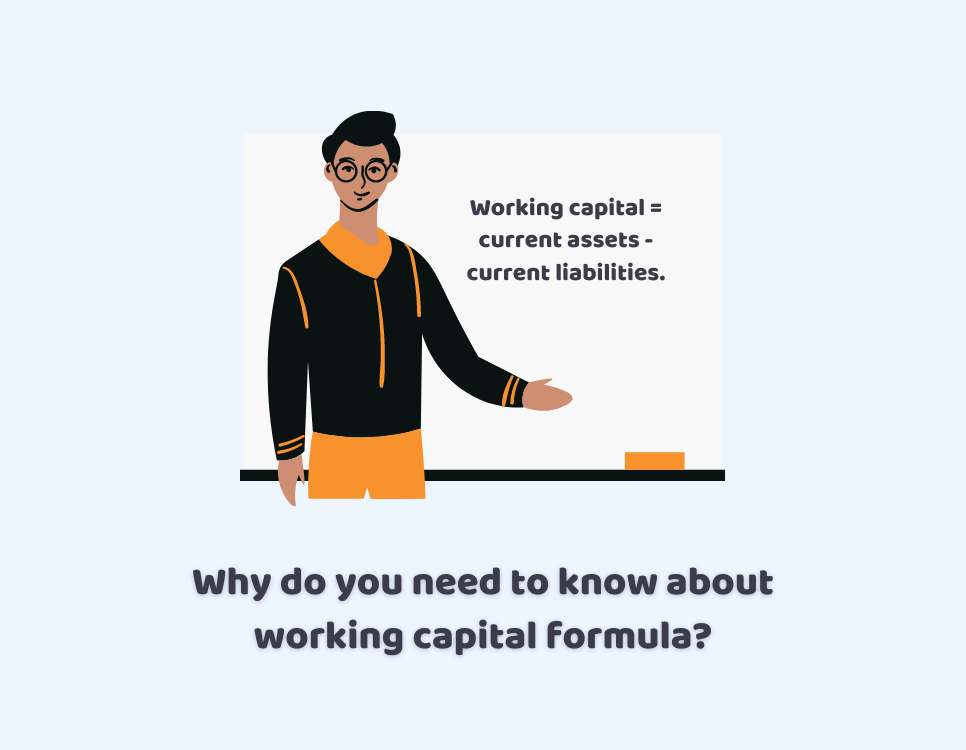
Why Do You Need to Know About Working Capital Formula?

08/07/2021Business , Finance

Do you want to measure the financial health and success of your business? Though you can get a fair view of your success through your customer base and profit, however, that’s not enough, there are numerous ways beyond. Along with other indicators, the working capital can let you know about your business standing and what finances it needs to meet its daily expenses. If you are running a business or willing to start one, you must know what you need to keep it afloat. Therefore, you need to have a good grasp of the working capital formula to rock in the business world. Let’s kick off with what is working capital. What is Working Capital? Working capital predicts the health of a business and provides information on funds that are needed to meet its day-to-day financial obligations. This information is necessary for the regular working operations of the business, that includes: Payment of salaries Reimbursement of suppliers Restocking products Office/factory maintenance Looking for a qualified accountant, bookkeeper or tax expert? Get in touch with us right now! What is Working Capital Formula? If you want to measure the short term financial health of a business, you need to use the working capital formula. It lets you know whether you have sufficient money to fulfil your financial responsibilities in the short run. To calculate use the following formula: Working capital = current assets – current liabilities. Current assets are the cash that you receive from sales. On the other hand, the money you are spending on expenses like IT etc are current liabilities. As your business needs regular cash to meet its day-to-day expenses and unexpected costs. A poor cash flow can’t cover that cost, which ultimately leads to the failure of a business. Besides, you need a great amount of working capital to face any emergency. This formula keeps you up to date about your cash flow situation for management accounts. If you have positive working capital, it implies that you can easily pay off your short-term liabilities. Conversely, a negative working capital indicates that you’re not in a condition to meet your debts. Consequently, it leads to cash flow problems that are the main causes of business bankruptcy, therefore it’s crucial to understand and monitor. Be worry-free about your business finances by getting in touch with CruseBurke! How to work out the working capital ratio? The working capital ratio indicates how frequently your business can pay off its current liabilities by using its current assets. If this ratio is less than one, there are more chances of financial difficulties. You can calculate it by: Working capital ratio = current assets/current liabilities Working Capital Requirement Startups often find it difficult to determine how much working capital they need at the beginning. As it is difficult to identify as it never remains constant and fluctuates regularly. Many businesses spend costs to provide resources for the production and delivery of their products and services. This happens as suppliers are needed to be paid before the reimbursement by your customers. For instance, the house builder needs materials like blocks, bricks, doors etc to build homes to sell. This cycle is called the cash flow cycle or operating cycle. You need to bear in your mind that, your funding requirements are dependent on the length of the cash flow cycle. It shows: Time for the production and provision of your products or services Duration of preparing and sending invoices for products or services Time required to get paid by the customers The working capital is essential to cover this time delay. As the longer the cash flow cycle, the more capital you need. Fo this reason, it’s imperative to put payment collection policies in place to ensure you’re reimbursed by the customers quickly. Quick Sum Up So, with the help of the working capital formula, you can better manage your cash flow. But, you need to track it on a weekly or monthly basis to know how and when you need funding to fulfil your business needs. Moreover, you also need to keep track of your quarterly VAT and corporation tax. These will be in separate saving accounts so that you don’t see them as spending money. An accurate and up to date cash flow forecast will let you know what’s happening with your working capital. Finally, with this, you can make better business decisions for its long-term success. Neet someone to manage the cash flow of your business? CruseBurke has a team of experts for your help, Contact us anytime, we’ll get back to you in the shortest time possible! For a customised package, Get an instant quote right away! Disclaimer: This blog is just for general information on working capital.

Read more
Cash Flow Forecasting

What is Cash Flow Forecasting? Process, Advantages

01/07/2021Business , Business Growth Ideas

Managing the financial affairs of a business can be overwhelming for many business owners. You don’t need to be an expert in accounting or bookkeeping, but you should at least have basic knowledge. One of the crucial components of finance is cash flow. So, you need to be well aware of cash flow forecasting to plan for the future growth of your business to keep it afloat. A cash flow forecast lets you know how much money your business is getting in and how much is going out. With this, you can make effective business decisions about what you can afford and how you can counter future cash flow problems. Need an accountant to manage your financial affairs, look no further other than CruseBurke! We provide tailored accounting and tax services for you at a reasonable price. Contact now! What is Cash Flow Forecasting? It is the process of forecasting or estimating the flow of cash that comes in and goes out from your business at a certain period. Besides, a cash flow forecast helps businesses to predict future cash positions, avoid cash shortages and get returns against the cash surpluses in the best way possible. Moreover, the finance team of the business bears the responsibility for forecasting the cash flow. However, the process requires input from the stakeholders and data sources within a company. Most often, large companies implement this process. How to Forecast Cash Flow? Forecasting the cash flow of a business depends on its objective, the requirements of the internal team or investors, and access to the data. Here is the general process that is recommended: 1) Know your business objective For an actionable cash flow forecast, you need to incorporate it with your business’ objective. Most commonly, it is used for: Managing the day-to-day cash Interest and debt reduction Forecasting future cash level Liquidity risk management Planning for business growth Save your time, money and energy by letting your financial affairs to CruseBurke. Feel free to reach out today! 2) Select a Forecasting Period After determining your business objective, you need to know what future period your forecast will cover. For accuracy, gather the maximum information from multiple sources where possible. For this reason, choosing a suitable period is crucial. Here is the list of some forecasting periods: Short-period forecasts Medium-period forecasts Long-period forecasts Mixed-period forecasts 3) Choose a Method for Forecasting There are two basic forecasting methods: direct and indirect. Direct forecasting uses actual flow data, whereas indirect forecasting uses projected balance sheets and income statements. 4) Gather the Data for your Cash Flow Forecast Find out the sources where you’ll get the data for your forecast. Generally, you can get the actual cash flow data from the bank account, where you’ll get data of account payables and receivables. In addition, you can take help from your accounting software to get the data. You should seek the following information from these sources: Opening cash balance for a specific forecasting period Cash inflows for the forecasting period Cash outflow for the forecasting period Advantages of Cash Flow Forecasting Along with avoiding cash shortages and getting more returns, a cash flow forecast can be advantageous for your business in many ways. Here is are some common advantages: Track your spendings Determine the future impact of plans and outcomes Keep track of overdue payments Plans for the cash shortages Manage surplus cash Help businesses to get out of debts Predictive business growth How We can Help CruseBurke has a team of accountants who can do cash flow forecasting for you. Moreover, we can provide you with a realistic picture of cash by letting you know about your current cash situation. We use modern software (e.g., Xero, QuickBooks) to generate accurate forecasts. We help you prepare for VAT bills and corporation tax deadlines. We support you in planning payroll or stock purchases in advance. Besides, we can help your business with future financial planning for a prosperous business future. CruseBurke offers affordable financial services! Get an instant quote today! Disclaimer: This blog provides general information on cash flow forecasts.

Read more
Profit and Loss Statement

A Beginner’s Guide to a Profit & Loss Statement

29/06/2021Accountants , Business

If you want to figure out how well your business is performing, one of the most important tools of your annual financial accounts is the profit and loss statement (P&L).  A profit and loss statement summarises a company’s sales and expenses typically within a financial year. You can easily prepare a profit and loss statement using accounting software, but if you are preparing it manually, it can be a bit difficult. For ease, you can get plenty of templates online for preparing a P&L statement. In this blog, we’re going to discuss: What is a Profit and Loss Statement? What is included in the P&L statement? How to prepare a P&L statement? Advantages and Disadvantages   Be worry-free about your business finances by getting in touch with CruseBurke!   What is Profit-Loss Statment? A profit and loss statement is also known as an income statement or the statement of operations. It provides summarised information about the revenue and expenses of your business. Based on your business operation, this statement can be prepared on a weekly, monthly, quarterly or annual basis. With this statement, you can get a deep insight into the financial health of your business by figuring out the profit or loss your business has made in a certain period. Besides, this statement allows you to compare your business performance in various accounting periods. In addition, you need this statement to work out various financial metrics like gross profit margin and net profit margin.   What is included in a Profit and Loss Statement? This document includes crucial pieces of accounting data that include: Revenue/Sales Cost of Goods Sold Gross Profit/ Profit Margin Operating Expense Depreciation and Amortisation Earnings before interest and tax (EBIT) Net Profit   How to Prepare a Profit and Loss Statement? You can prepare a P&L statement yourself, although many business owners prefer to choose an accountant for proper sequencing and accuracy.  The P&L statement needs to provide a clear picture of all the sources of income and expenditures of your business. Here is the basic guide for preparing a P&L statement: Choose a timeframe of your statement to get a meaningful date List down your business revenue within this period Calculate your expenses like COGS, OPEX Work out your gross profit by subtracting direct cost from your total revenue Figure out whether you’re making money by subtracting your total expenses from the gross profit If you have all the relevant data, you can prepare it without any hassle.   Steps to Prepare Your Profit and Loss Statement You can not perform all the calculations by yourself, as some appear to be simple, but they require professional help. However, if you do more work, then your accountant will take less time to finish off. The steps you need to follow are as follows: Create a top row for total sales if you are running a trading business or total income if you are running a service business. Create it by utilising your financial management software or a spreadsheet. Every column should show a different month, generally beginning from the start of your tax year or from the month in which your company incorporated. Some rows below create another row for other business revenue. This can include other revenue like, interests on business investments or savings. For “total turnover”, create a third row. It contains the sum of the first two rows (total income, total sales, and other business revenue are added together). Insert another row named COGs (cost of goods sold), which includes the total expenses or cost of stock of that month. Now add a row for the total cost of sales. In it, you will put the total of your stock purchases or your expenses. And, finally, add a row underneath titled “gross profit”. It will contain your total turnover – total cost of sales. To give details information about your expenses in different categories, insert a series of rows below it. These categories will contain staff costs, travel costs, marketing & advertising expenses, utilities, insurance, and rental costs, bank and other financial charges, professional fees, depreciation on business assets, office costs, irrecoverable liabilities written off, and other business costs. Add all of these expenses, and then deduct this figure from your gross profit or loss. By following these steps, you will get your net profit or loss figure for the accounting period.   Need help from our experts to prepare a P&L statement for you. Contact us today!   Advantages Here are some of the prominent advantages of P&L statement: Track business performance Identifies financial trends These advantages are acknowledged by many accountants and bookkeepers.   Disadvantages Along with its benefits, there are some disadvantages of it too that can’t be overlooked. These include: Requires a lot of work Not 100% reliable to gauge the financial performance   Quick Sum Up To sum up, we can say that it is better to get the help of a qualified accountant to create a profit and loss statement for your business. If you want to prepare it yourself, you are advised to use accounting software to avoid pitfalls. Get the help of our qualified accountants to prepare a P&L statement for you. Get an instant quote right away!

Read more
What are Current Assets

What are Current Assets? Definition, Classification, Calculation, and Example

25/06/2021Accountants , Business

Every business needs assets for carrying out its business operations. Whether you’re a technician, doctor, business owner or a company’s director, you need to be well aware of your current assets to efficiently operate your business for generating more revenue. If you’re a new business owner or a veteran looking to polish your accounting skills, you’re at the right place as we will be discussing, what are current asset, how they are classified, how to calculate them and we’ll also see the examples of current assets to get a deep insight into it. Read on to clear all your ambiguities on current assets.   Get tailored accounting and bookkeeping services for your business with CruseBurke. Contact now!   Current Assets – Definition Current assets are those assets that can be converted into cash or liquidated within the time limit of one year and they’re listed as the first items on the balance sheet. These assets are the key component of the working capital and the current ratio. These assets help businesses to pay their ongoing and regular business expenses like rent and bills. There are many types of current asset including cash, inventory, account receivables, prepared expense and market securities, etc. Current assets are not long-term assets as they can’t be converted into cash within one year. Long-term assets include building, machinery or copyrights. After discussing, what are current assets. Let’s see how they’re classified.   Classification of the Current Assets Current assets are included or classified in the assets section of the balance sheet. If we take it broadly, there are five types of financial statement. These are: Balance sheet Income statement Statement of change in equity Statement of cash flow Notes to financial statement Current assets are only recorded in the balance sheet. They can be the most liquidated assets and sometimes they can also be the less-liquidated assets. Like cash and equivalent of cash are on the top of the current assets that are easily liquidated whereas inventories and loans come afterwards.   How to Calculate Current Assets? Calculating the current assets is pretty simple and straightforward. If you’re aware of the basics of accounting, you can easily calculate them through this formula:   Current Assets = Assets – Non-Current Assets        OR Current Assets = C + CE + I + AR + MS + PE + OLA Here: C = Cash CE = Cash Equivalents I = Inventory AR = Accounts Receivable MS = Marketable Securities PE = Prepaid Expenses OLA = Other Liquid Assets   Unable to calculate current assets. Let us know!   Examples of Current Assets​ Generally, current assets include cash on hands, cash in the bank, account receivables, inventories, marketable securities and other types of short-term investment. These also include: Cash and Cash Equivalent are those current assets that are easily converted into cash. These are cash on hand, cash in bank, petty cash, cash advance and other assets that easily cash convertible. Prepaid expenses are also classified as the current asset if the services or goods are expected to be received within the time frame of one year. If not, they’d classified as fixed assets. Account receivables are also a current asset that customers are going to pay within the timeframe of one year. Inventories are also current assets as they are the stocks that companies hold for their business. It includes raw material, and finished goods etc. Short-term deposits are also considered current assets. All of these need to be recorded in the balance sheet however, some may be put into the income statement when they are sold or used.   Quick Sum Up To sum up, we have discussed what are current assets, how they are calculated and classified, and what are the examples of current assets. Hopefully, after reading this post you have got a clear idea of the current asset. Remember that balancing the current assets with your liabilities will be helpful for effectively utilizing the finance of your business, raise funds, and meet your day-to-day business goals.   If you are looking for an expert to record, manage and monitor your financial statements, look no further other than CruseBurke. We have a team of expert bookkeepers and accountants for your assistance. Don’t hesitate to get in touch with us.   Disclaimer: This blog is intended just for general information on current assets.

Read more
Crowdfunding for Business

The Pros and Cons of Crowdfunding for Business

21/06/2021Budgets & Other , Business

With increasing popularity, crowdfunding has become one of the most viable ways to raise capital for your business. The emergence of platforms like Kickstarter and Indiegogo has taken its popularity to its peak by raising funds for startups and medium-scale businesses. The process of getting funds via these platforms seems easy, exciting and simple but it isn’t that easy and simple. While Crowdfunding for businesses can be a great way to generate capital, it’s not the ultimate solution to getting funding. Let’s explore it by discussing its pros and cons. In this blog, we’re going to explore: What is crowdfunding? Types of Crowdfunding Pros and Cons of Crowdfunding Best Crowdfunding Platforms   What is Crowdfunding for Business? To put it simply, crowdfunding is the process of getting a small amount of money (capital) from a lot of individuals (crowd) to kickstart a business venture. Crowdfunding platforms reach a vast number of people through social media or crowdfunding sites where investors and entrepreneurs meet to help new businesses through the pool of investors.   Manage your business finances with CruseBurke. Just let us know your need for affordable financial services tailored to your business needs!   Type of Crowdfunding There are four major types of crowdfunding for businesses, where they can get money from various investors/donors. These are:   1) Donation-Based Crowdfunding In this type of crowdfunding, people provide money for a company, person or campaign without getting anything in return. For example, your company needs machinery for its operation. The investor or donor will provide you with the money as support for your business growth without any other interest.    2) Debt-Based Crowdfunding This is crowd-based lending, where people provide debt-based donations as a loan that is needed to be repaid along with the interest.   3) Reward-Based Crowdfunding Unlike debt-based crowdfunding in reward-based crowdfunding, the lender receives a reward against the money they invested or donated. The rewards vary based on the amount of donation or company. Here lenders get a reward like a t-shirt, service or product against their fund. These gifts are often provided at a discounted rate.   4) Equity-Based Crowdfunding Here the small businesses allow lenders or donors to take a small portion of their business against their funds. These donations are like investments now in which the investors receive shares of the businesses based on their business amount.   Pros and Cons of Crowdfunding No matter what type of crowdfunding you choose, it can be a great place for new businesses. Here are some of the benefits of crowdfunding:   1) Mitigate Financial Risks There are fewer financial risks associated with crowdfunding. It’s one of the best ways to access the viability of your business before making a huge investment.   Reduce your financial risk with our accountants. Reach out today!   2) Validates your Business idea A successful crowdfunding campaign can be great for your business as it is validated by a large number of people. You can eliminate your doubts and can know whether there’s demand for your services or products in the market or not.   3) Great Amount of Money You can kickstart your business venture by getting ample money through crowdfunding   4) Financial Advice and Support Along with financial support, you can get new ideas and feedback from experts and others to boost your business.   5) Great Alternative to Banks Securing bank credit is a daunting task whereas crowdfunding provides your different types of donations, funding, and interest-free loans etc.   6) Business Promotion With crowdfunding, you need to invest in marketing or advertising to promote your business as crowdfunding platforms do it for you without any hassle and free of cost. Along with a lot of benefits, crowdfunding also contains some cons that need to be considered beforehand:   1) Need time and money to invest To make your campaign successful you need to do a lot of efforts. You may also need to invest time and money to build prototypes, videos and content and market it.   2) Chances of Failure There are many chances of failure as there is a lot of competition in the market. Along with the embarrassment, your money and time can be wasted.   3) Administration and Accounting While crowdfunding websites provide many services but still have to keep a record of investors, rewards, contributions and shareholders etc. Moreover, you also need to keep accurate books of your business to provide a fair share of profit to each investor. And it can be a daunting process.   Don’t worry we have the solution. CruseBurke has a team of accountants to provide affordable financial services for you. Feel free to reach out!   4) Theft of Idea You might have got an innovative idea, but it can be stolen by any other person unless it is patented and you have copyrights and trademarks in place. Some people could steal your idea to come up with a better version of it.   5) Not suitable for all businesses Crowdfunding can be a great place only for a business that’s dealing with consumer-facing products like bags, shoes, garments etc but it can not suit for service-based businesses like a salon, catering, etc. Let’s see what are the top crowdfunding platforms of the world.   Best Crowdfunding Platforms Here is the list of some great crowdfunding platforms from where you can fuel up your business: Kickstarter. Indiegogo. Patreon. GoFundMe. Chuffed. ArtistShare. MightyCause. InKind. Crowdfunder. Give. Charitable. Lending Club. AngelList. Ulule. Funding Circle. Seed&Spark. Crowdcube. GoGetFunding. Fundable. Fundrazr. Kiva. Before signing up, you need to read the guidelines of each platform to find out whether you meet their eligibility criteria or not.   Quick Wrap Up To sum up, we can say that crowdfunding for business can be a great way to raise funds for some businesses. However, there are still many businesses that can’t fulfil their fundraising goals through it.   It is always advisable to get help from a financial advisor for …

Read more