
Cloud Based Accounting

Cloud Based Accounting – Why It is Good for Small Businesses

08/09/2021Accounting , accounting software , Business

Many businesses and accountants are shifting towards cloud-based accounting. They are requesting cloud based solutions, and the trend of using this technological innovation is increasing at a rapid pace. The cloud is making your data and information all times available, and you can access it anytime, anywhere from any smart device. However, there are still some SMEs who are reluctant to move towards cloud accounting. So, in this blog, we will inform you about the advantages of preferring cloud accounting.


Allow us to move all your business finances to the cloud with the best-suit accounting software at reasonable prices!


What is Cloud Based Accounting and How it Works?

In cloud accounting, you keep your company’s records such as revenues, expenses, assets, and liabilities available on the internet. It is secure and reliable as data is encrypted and can only be accessed by the person who has a valid password. In addition, there are many free software accounting apps available for managing bills, invoicing, etc. Click here to know more about the best small business accounting applications.

You can move your business books to the cloud by subscribing to online accounting software. After that, you can access your data anytime, anywhere, on any web browser, and with any available smart device. You can also save yourself from a lot of data entry by connecting the software with your business bank account as the banking operations proceed systematically (from the bank to the books).


Advantages of Cloud-Based Accounting?

There are many advantages of using cloud accounting, which are as follows:
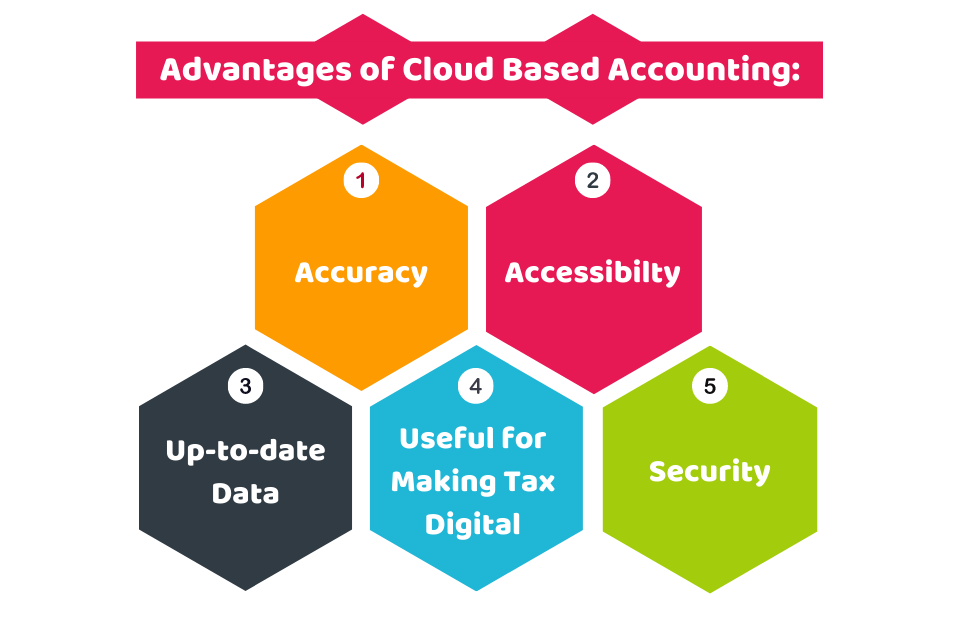
Advantages of Cloud Based Accounting

1. Accuracy

With the technologies like AI (Artificial Intelligence) and OCR ( Optical Character Recognition) developing capabilities, accuracy levels are increasing. It eliminates the risk of inaccuracy and the need for human re-entering by automatically generating data to other relevant fields.

2. Accessibility

You can access your finances anywhere, at any time, and from any smart device. It provides you the freedom to access and manage your business finances on the go.

3. Up-to-date Data and Saves Money

When you input your financial information, it will be instantly available to all of your company team members no matter where they are, and data will always remain up to date. Cloud accounting can save your money as it does not require any IT staff for maintenance, and you only pay the subscription fee. There are no extra costs for the updates and upgrades.

4. Useful for Making Tax Digital (MTD)

To digitally provide updates to HM Revenue & Customs monthly and to keep records of the business finances, many SMEs above the VAT threshold will be obliged to move towards cloud accounting. So to save yourself from any panic situation in the future, you should move your business data into the cloud now.

5. Security

The software companies make sure that the privacy of your data and security is always airtight. In addition, your data is systematically backed up and stored offsite (to keep it secure from cybercrime).


Final Thoughts

We hope now you are well aware of the advantages of moving towards cloud-based accounting. You can run your business remotely and be sure that the finances of your company are accurate and up-to-date. Cloud and accounting software are the best matches because they provide you with the flexibility to enjoy endless possibilities as data is accessible 24/7. In addition, it helps the owner of a company stay connected with their accountants and business finances.


CruseBurke has a team of professionals that manage your finances with the best cloud-based accounting software! Contact us now!


Disclaimer: This blog contains general information about cloud based accounting.


Related post

year end accounting checklist
What are the Tips to Get Your Books Ready for End of Year?

05/01/2023Accountants , Accounting , Accounting Issues , Bookkeeping

It becomes critical and hectic especially for the finances team when the tax year is coming towards an end. It is a tendency among businesses that the finance professionals get their owners burry under the heps of accounting requirements, financial reports, and other relevant statements. It takes around a month time period for the accounting professionals to be prepared for the year closure. This usually makes the accountants overwhelmed with the work requirements. The year-end accounting checklist helps maintain focus on getting everything ready before the deadline approaches. Moreover, the best way to lessen the overwhelming burden and improve the productivity level in this busy period of the year is to make a set of workflow that can really help. This is also an easy method that will reduce your work stress as well. We have compiled this article to give you a good head start. We have focused on outlining the important steps that will make the year-end closing cycle a successful experience for you. Let us get delved into the discussion without missing any tips and ways to make this happen. Talk to one of our intelligent and clever professionals to get further queries about the year-end accounting checklist. We will ensure to come up with the best possible solution. A Short Introduction to the Year-End Close The year-end close is also famous with the name of closing the books. It is a procedure in which the professionals do a review, and verification of all the financial transactions, recompilation, and add up the ledgers of the company from the previous fiscal years. This has the involvement of equity, investments, assets, revenue, income, and other calculations of the business expenses. The goal of this annual closure is to make the financial statement finally, which will help for the potential audit externally. This will keep the official financial records of the company in a sorted and managed manner. Moreover, the founders of the company are allowed to choose the year-end date that goes according to their business suitability. The duration of the fiscal year must be of 12 months. This should be fitted best with the industry and the company’s requirements. Why is it so Difficult to do the Year-End Closing? It is challenging and overwhelming when it comes to the year-end closing. Often, professionals and accountants are found to seek help from others. So that their workload can be reduced. We have outlined some of the common problems that make it challenging for accountants throughout the financial year and at the year-end closing. This involves the following: The inefficient communication of the employees makes the process more difficult. The accountants are often found running after the employees for the sake of missing documents. The manual entry of the data is another challenge. This not only takes a lot of time, but the chances of errors are also high in this method. It is challenging to juggle the files of paper. Human errors are possible even if the professionals are organised to a good level. It just has to be a simple wrong entry and this can give you costly consequences. The missing invoices and receipts are another major issue. This can even cause some major delays in meeting deadlines. What are the Ways to Make the Year-End Closing a Little Easier? This is like a dream for professionals to seek ways that can make the year-end closing a little easier and less stressful. The good news is that there are certain ways to do so in reality. Being ahead in planning the year-end closing is one of the popular ways. When you are on top of handling your finances throughout the year, this will work as the most effective way to cut down the level of stress while you are closing the year-end finances and other requirements. You must ensure that laborious reconciliations is done already so that your accounting professionals can spare the time to focus on the business goals for the coming up year, setting the budget, making financial reports, and reviewing the ledgers. What is the Year-End Accounting Checklist? There are several steps recommended by professionals that are related to double-entry accounting well. This will even help to close the books and either requirement right on time. 1- You must be preparing your year-end closing schedule to be on top of your performance game. You must know the delaine of the fiscal year and other important dates of the business activities. You can even create a calendar to focus on important deadlines. 2- You must gather all the receipts and outstanding invoices. 3- You must record the entries that are adjusted. This should involve the reconciliation of all the cash accounts. 4- You should close all the payable and receivable accounts as well. 5- If you want to start your new fiscal year with the right financial position, you must focus on accrue accounts receivable. 6- Keep a track of the accrued accounts payable. 7- Adjust the entitlements and the grants wherever required for the business’s betterment. The Bottom Line Now that you have gathered a fair amount of information about the year-end accounting checklist, we can bring the discussion towards wrapping up. Getting your books ready and set for the upcoming new fiscal year means that you are in a good financial position with your business to make the right business choices and start your financial year. However, the professionals often state a few tips to be on top of this game. We hope these few minutes of reading will help you develop a better understanding of the year-end accounting checklist. As well as how to deal with them professionally in the future. If you seek professional help, learn more about the year-end accounting checklist. Why wander somewhere else when you have our young and clever team of professionals at CruseBurke? Disclaimer: The information provided in this blog is about the year-end accounting checklist, including the text and graphics, in general. It does not …

Read more
FreeAgent vs QuickBooks
FreeAgent vs QuickBooks Online

15/12/2022Accounting , accounting software

If you are the owner of a small business in the UK, each penny that you spend on your business will count in this journey. This will make you think twice before making any decisions regarding the business. Also, spending on buying accounting software that is just suitable for your unique business needs is also imperative to be cautious. People often get confused in making decisions between FreeAgent vs QuickBooks. These are known to be the top two famous options designed for entrepreneurs. You must be wondering whether to go with FreeAgent or QuickBooks to meet your business needs. Well, this article has covered what you might wonder about before you decide to choose the right kind of accounting software for your unique needs. This involves the discussion of what the targeted audience is for FreeAgent and QuickBooks, which one is the most suitable option for you, what features make both options differ from each other, and how is user-friendly. Talk to our best accountants and bookkeepers in the UK at CruseBurke. You will get instant help about FreeAgent vs QuickBooks, whether you are running a small or large business. FreeAgent vs QuickBooks In the case of both FreeAgent and QuickBooks, they tend to target the entrepreneur market. Usually, the claim by these options tends to give us an explanation that they are able to cater for the business needs, whether it is a small-sized business or a large-sized business. However, in actuality, these are most suitable for smaller-sized companies and digital businesses. What is Suitable for Your Business Type – FreeAgent vs QuickBooks? You are not going to need any of the employees who will see and cater for your account once you have opted for the smart accounting software, considering your business needs. You will find yourself in a position to be free from managing and balancing the transactions of money and relevant details. As an owner, you should not be doing that rather, you must focus on the business growth ideas. It is also imperative to understand here that such programs are specially designed for small businesses and will be most suitable for them as well. If you think your business is associated with a treble-figure employee headcount or you have complicated accounting needs, this option will not suit you. You must go for another accounting package that can meet your business needs. What are the Available Features? A full-service accountancy software package is covered under both FreeAgent and QuickBooks accounting features. This will help you to keep a good track of your incoming and outgoing money. The spending is in the form of business expenses and your income. You can even get payroll services with these packages. However, if you have opted for QuickBooks, you will have to pay a little extra to avail yourself of this feature. What makes QuickBooks different from FreeAgent is that it has a more complex reporting option in comparison to other accounting software. This is why FreeAgent refers to a one-stop shop that can cater to all the basic needs of accounting for your small business. However, in the case of QuickBooks, manufacturing requirements and other challenging tasks of accounting can be catered to. At CruseBurke, we support both FreeAgent and QuickBooks clients, and we can help you choose the right software based on your business model. Whether you need simple bookkeeping or more advanced reports, our certified experts in Croydon are ready to assist. Which Accounting Software is more User-Friendly? If you are wondering which one is the most user-friendly option for accounting, then we can say that both compete with each other well in this regard. They aim to make you worry-free from the need for an accountant to keep your books and other accounting records. These offers ensure to make the experienced user-friendly on the same level. If you try to compare the intuitive user interface between both options, this will be a tie. At the initial stage of the business, you can use QuickBooks as a suitable option as it will cater to all the basic accounting needs of your small business; however, the other option offers some complex features that might confuse beginners, and they might not even find it user-friendly at this stage. The Bottom Line Now that you have gathered a fair amount of information about FreeAgent vs QuickBooks, we can bring the discussion towards wrapping up. Generally, people find both the packages offered by this accounting software as the same, with a little difference in offering the complex and basic features. This totally depends on your business needs, which you will have to identify to choose the most suitable option for you. We hope these few minutes of reading will help you develop a better understanding of FreeAgent vs QuickBooks and how you can make a choice that turns out to be the most beneficial to your unique circumstances. Are you seeking professional help to learn about accounting software for a small business? Why not get help from the experts at the CruseBurke? Talk to us now! Disclaimer: All the information provided in this article on FreeAgent vs QuickBooks includes all the text and graphics. It does not intend to disregard any of the professional advice.

Read more